
Confusion – The emotion that hits us when we look at a restaurant menu with too many dishes or when opened a shopping website, saw hundreds of products, and end-up closing the page without buying anything.
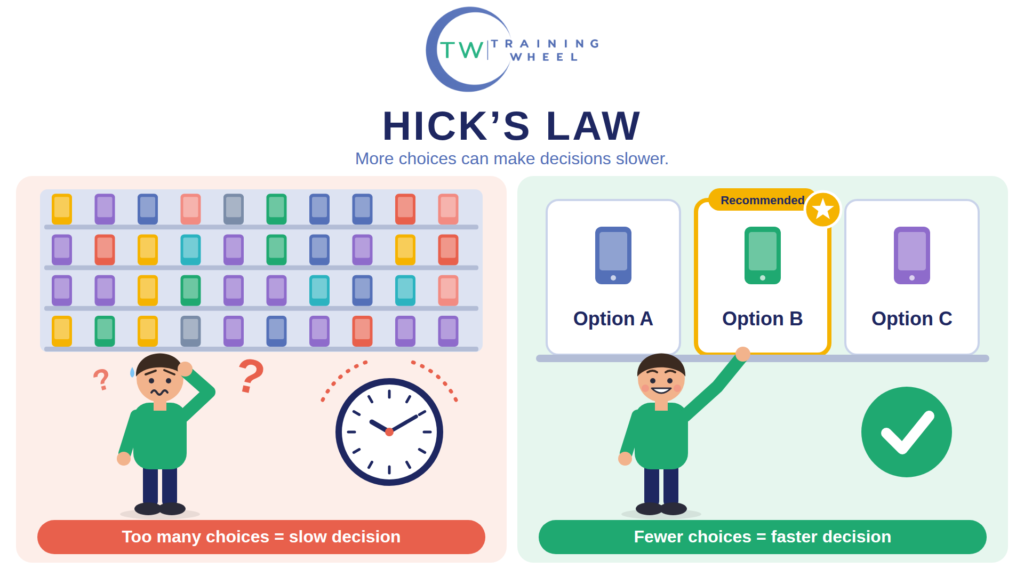
This happens to most of us. The more choices we have, the longer it can take to decide. This idea is known as Hick’s Law.
In simple words, Hick’s Law says: the more options people have, the more time they need to make a decision. It was named after psychologists William Edmund Hick and Ray Hyman, who studied how people react when they are given different numbers of choices.
What Hick’s Law Means
Hick’s Law does not mean that every extra choice is bad. Sometimes we need options. The problem starts when there are too many similar choices and it becomes difficult to compare them.
For example, choosing between three mobile phones is usually easy. But choosing between thirty phones with similar features can feel stressful. You start comparing prices, cameras, battery life, storage, and reviews. After a while, you may feel tired and put off the decision.
This is called choice overload. When people feel overwhelmed by options, they may take longer to decide, doubt their choice, or avoid making a decision at all.
Business Examples
Businesses can learn a lot from Hick’s Law.
A website with too many buttons, menus, and links can confuse visitors. If people do not know where to click, they may leave. A clear page with one main action—such as “Book a Demo” or “Start Free Trial”—is usually easier to understand.
Product pricing works in a similar way. Many companies offer three plans: Basic, Standard, and Premium. This helps customers compare options quickly. If a company offers twelve plans with small differences, customers may feel confused and delay their purchase.
Salespeople can also use this idea. Instead of showing a client every possible product, it is often better to recommend two or three suitable options. This makes the conversation clearer and helps the client make a confident decision.
Email marketing is another good example. An email with one clear button, such as “Download the Guide,” is easier to follow than an email with five different links. Too many choices can distract readers from the main action.
General Examples
Think about streaming platforms. You open the app to watch something for 30 minutes, but after scrolling through hundreds of films and series, you still have not chosen anything. The large number of options makes the decision harder.
The same thing can happen when shopping. If a shop offers only three types of shoes, you can compare them quickly. But if it offers fifty similar pairs, you may spend an hour looking and still leave without buying.
Even planning a holiday can be affected. Choosing between two destinations is simple. Choosing between forty destinations, hundreds of hotels, and countless activities can turn a fun plan into a stressful task.
How to Use Hick’s Law
Here are some simple ways to apply Hick’s Law:
-
Offer fewer choices. Keep only the options that are truly useful.
-
Make the best option clear. Use labels such as “Most Popular” or “Recommended.”
-
Use one main call-to-action. Tell people exactly what to do next.
-
Group similar products. Put options into categories such as price, size, or purpose.
-
Simplify forms. Ask only for the information you really need.
-
Watch customer behaviour. If people hesitate, abandon their carts, or leave a page, the process may be too complicated.
In conclusion
Hick’s Law teaches us an important lesson: more choice is not always better. Sometimes, people need fewer options and clearer guidance. Whether you are designing a website, selling a product, writing an email, or making a personal decision, simplicity can help people act faster and feel more confident.